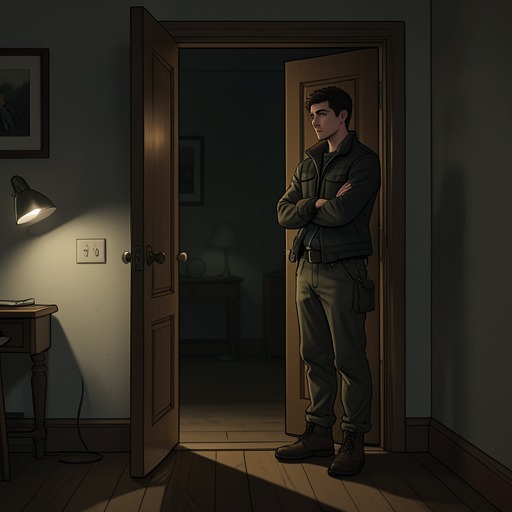
Travis McCoy returns to Clarendon
The Journey CollectionTravis McCoy returns to Clarendon not as the triumphant athlete the town remembers, but as an injured, uncertain man forced to confront the past he abandoned. The journey begins with a homecoming invitation and culminates in his public reentry into the community, where football, family, and forgiveness become inseparable. His return changes the meaning of home: Clarendon is no longer merely the place he left, but the place where he can begin to become a partner, father, husband, and eventual mentor.
The Invitation and the Decision
The return is prompted by a letter from Jack Garrison, the principal of Clarendon High School. Bearing the maroon shield, silver C, and paired silver broncos of Travis’s alma mater, the letter invites him to the school’s week-long homecoming celebration and praises both his professional success and the integrity he is believed to represent. The principal explains that the current football team is having its best season since Travis left and that its players, who were only beginning pee-wee football when he led Clarendon to a state championship, specifically asked for him to attend. Their request transforms the invitation from a ceremonial honor into a summons from a younger generation that has inherited his example.
Travis does not answer the letter directly. After rereading it several times, he lets it fall onto his foot and questions whether a town he left after making a mess of his life could still welcome him. His hesitation is not simple modesty; it reveals the emotional cost of his absence and his fear that some damage cannot be repaired. A month later, however, he leaves his apartment, enters a yellow taxi, and orders the driver to take him to the airport. Instead of confirming his attendance to Jack Garrison, he quietly books a flight back to Texas. The choice is therefore both an act of return and an act of uncertainty: he decides that understanding his future requires him to face his past, but he cannot yet promise what he will find there.
Crossing Back into Clarendon
The journey itself is difficult and physically revealing. Travis flies from Miami to Dallas, suffers an almost two-hour delay, and barely catches his connection to Amarillo. During the flights, admirers ask him to autograph newspapers, magazines, and even barf bags, reminding him that he remains publicly recognizable as a professional football star. Yet his shoulder, recently freed from its brace, is stiff, painful, and markedly limited in mobility. The same body that made him famous now carries rumors that his career is ending, while the lost luggage office leaves him waiting for more than half an hour among other frustrated travelers. His status as a celebrated athlete offers no protection from uncertainty or inconvenience.
Driving back from the airport in his black 1966 Pontiac GTO, Bertha, Travis encounters a Clarendon that is both familiar and slightly altered. A new convenience store has replaced two failed gas stations, while Clayton’s Groceries remains open beneath a fresh coat of red paint and a new sign. The bank, insurance offices, and pharmacy display support for the local football team, making the town’s civic identity visible in ordinary storefronts. Travis’s conclusion that not a damn thing has changed is less a literal description than an emotional recognition: the town’s public rituals and loyalties have survived the decade in which he kept himself away.
The high-school gymnasium becomes the threshold of his return. From the car, Travis hears the fight song, the crowd, and the noise of students, parents, and fans gathered for the pep rally. He remembers the Friday afternoons when he sat before the same watchful community, recalling that he both hated and loved the attention. When he enters, the packed bleachers, additional spectators lining the walls, maroon-and-white uniforms, silver accents, posters, and chanting cheerleaders recreate the world of his youth. The homecoming queen ceremony initially allows him to remain hidden, but the concealment cannot last: the community has gathered not only to celebrate the team but to call its former leader back into public view.
The Homecoming Rally and the Field
The rally places football within a larger civic and religious ceremony. The players enter to the fight song, the cheerleaders lead the Pledge of Allegiance, and the band plays The Star-Spangled Banner before the crowd begins urging the team toward its game against the Gruver Greyhounds. The annual rivalry recalls Travis’s senior year, when students burned a papier-mâché Gruver player in effigy at the bonfire. Drought has forced the cancellation of the bonfire this year, but not the rivalry’s communal energy. The altered ritual shows a community adapting its celebration without surrendering the memory and identity attached to it.
Cody asks Travis to lead the players through the Lord’s Prayer. Travis kneels with the boys and recites it while their murmured voices join his, then follows them toward the inflatable tunnel and the field. The sequence makes his return more than a speech by giving him a temporary position within the team’s ritual life. He is not simply being remembered as a former champion; he is being asked to perform service for the present team, lending his authority to the moment before the players take the field.
When the team is introduced, Jack Garrison identifies Travis as a member of the championship squad and one of the school’s most successful alumni. Travis then leads the Broncos through the tunnel. At the fifty-yard line, surrounded by the crowd’s roar, he recognizes that the emotional force of standing at home exceeds the spectacle of the largest professional stadiums he has known. He tells the players that the applause belongs to them because they have worked hard and earned the community’s respect. By striking the backs of their helmets as he passes, he combines affection with public encouragement, treating the boys as athletes whose courage already carries the hopes of the entire town.
His message also changes the value at stake. Winning matters to the players, but Travis insists that the community’s pride is grounded in effort, respect, and character rather than the final score. The man who once defined himself through professional achievement now gives the team a standard that cannot be measured only by victory. His homecoming therefore begins converting football from a private career and a source of fame into a language of responsibility, belonging, and intergenerational example.
From Public Return to Family Formation
Clarendon’s public welcome quickly becomes entangled with Travis’s private life. During the rally, he sees Penelope Stone and Max among the elementary-school children. Max waves with an enormous grin, Travis returns the gesture, and he acknowledges that his feelings for Penelope remain strong. He understands that he still loves her and needs both her and Max, imagining the three of them as a family. The homecoming thus exposes the deeper purpose of his journey: returning to the town also means returning to the people whose lives were altered by his earlier departure.
The subsequent family milestones show how the return develops into durable commitment. Travis tells Penelope that he has loved her since he was fourteen and proposes marriage with a small black velvet box; she answers yes. He then asks to change Max’s last name legally to McCoy, explaining that if Penelope is to become a McCoy, he wants Max to share the name so that they can be a real family. Penelope accepts, and the proposed name change turns biological fatherhood into a public and legal bond.
That bond is completed in the wedding ceremony held on the football field. The field is transformed with a white wooden arch covered in honeysuckle, flickering eight-branched candelabras, rows of white chairs with gold satin bows, lanterns, balloons, and an ivory aisle runner. The site of Travis’s athletic return becomes the setting for his family’s formal beginning. During the ceremony, Travis and Penelope bring Max between them to light the eternity candle together, making him an active participant rather than a passive witness to their marriage. The football field consequently shifts from a place of former glory to a shared domestic and spiritual space.
The return also leads into a future that extends beyond the original reunion. At a later family gathering, Russ McCoy discovers an ultrasound photograph in a silver frame and reacts with shock and emotion, revealing that Travis and Penelope are expecting another child. The image places Travis’s return within an expanding family line: the homecoming does not restore an earlier life unchanged, but opens a new one in which fatherhood, marriage, and future children give his identity a different center.
Narrative Significance
Travis’s return follows a pattern of separation, threshold crossing, and reintegration. He leaves the professional world of Miami with an injured shoulder and an uncertain career, passes through airports and the familiar yet altered streets of Clarendon, and reenters the community through its most public ritual. The progression is not a simple victory lap. His old athletic identity is acknowledged, but it is also placed under pressure by injury, regret, and the need to answer for his absence.
The homecoming rally functions as a communal act of recognition. The Pledge of Allegiance, national anthem, prayer, fight song, school colors, championship memory, and field ceremony unite local loyalty, religious language, civic symbolism, and football tradition. Travis’s return becomes meaningful because the town witnesses it, while his leadership becomes meaningful because he redirects attention from his own accomplishments to the young players’ work and character.
Most importantly, the return converts nostalgia into action. Travis does not merely revisit the places associated with Penelope, Russ McCoy, and his championship past; he makes choices that bind him to the future. He proposes to Penelope, claims Max through the McCoy name, includes Max in the wedding ritual, and becomes part of an expanding family. Clarendon welcomes back the athlete it remembers, but the story’s decisive achievement is the emergence of a man who can remain: someone whose home is defined not by the stadium’s applause, but by responsibility to Penelope, Max, and the family they build together.